tag:franco.nd.edu,2005:/newstag:franco.nd.edu,2005:/latestFranco Family Institute for Liberal Arts and the Public Good | News2026-07-06T14:27:00-04:00From getting projects off the ground to sharing their impact with the world, the Institute for Scholarship in the Liberal Arts ensures faculty and students at all levels get the research support they need and the scholarly recognition they deserve.tag:franco.nd.edu,2005:News/1828772026-07-06T14:27:00-04:002026-07-06T14:27:09-04:00Notre Dame Arts Initiative awards over $400,000 for community and campus partners to lead inaugural Arts Biennial programming
The Notre Dame Arts Initiative has awarded 38 grants to foster sustained growth in the arts through partner programming for the inaugural Notre Dame Arts Biennial, scheduled for January through June of 2027. Awardees include 16 regional community partners, 19 campus units, and four Notre Dame Global locations, with another 60 campus units and external organizations involved as collaborators. In addition to funding, partners receive administrative support from Arts Initiative staff for planning, implementation, and promotion.
Projects include theatrical premieres, regional dance and music festivals, multimedia installations, visual art and architecture exhibitions, high-impact arts education programs, international artistic exchange, and more. Biennial programming is open to the public, and events will be held on Notre Dame’s campus, in and around South Bend, and at select global locations.
Occurring every two years, the biennial is an international arts festival rooted in the creative spirit, intellectual energy, and iconic traditions of Notre Dame and the region. Predominantly free programming across the visual, spatial, literary, and performing arts will contribute to the region’s long-term flourishing by enhancing quality-of-life and quality-of-place and by providing new platforms for arts research to positively impact the public.
In his inaugural address, University President Rev. Robert A. Dowd, C.S.C., urged the Notre Dame community to be builders of bridges to live out our mission as a leading global Catholic research university. The biennial is one of the most visible ways the Arts Initiative is responding to that call.
“This scale of coordination and collaboration is unprecedented,” said Michael Schreffler, director of the Notre Dame Arts Initiative. “We are grateful to all of our partners for bringing their energy and leadership to fully realize the vision of the biennial’s inaugural theme of symbiosis: a call to contemplate mutually-beneficial relationships through the arts and create them together in practice.”
Community partners leading biennial programming reflect the strength and diversity of arts and culture across the region. Participating regional community partners include:
Abby Marchesseault Dance Studio
Acting Ensemble
Equity in the Arts, an initiative of South Bend Venues Parks & Arts
Goshen College Music Center
Fischoff National Chamber Music Association
The History Museum
Lubeznik Center for the Arts
Merrimans’ Playhouse
New Industry Dance
Performing Media Festival, produced in partnership with IU South Bend
Saint Mary’s College, Department of Art
South Bend Civic Theatre
South Bend Community School Corporation
South Bend-Elkhart Regional Partnership
South Bend Museum of Art
South Bend Symphony Orchestra
Campus units awarded funding for partner programming similarly span artistic media and represent a University-wide commitment to interdisciplinary innovation. In addition to projects housed in arts departments, campus efforts are also being led by the College of Science, Hesburgh Libraries, the School of Architecture, and a range of interdisciplinary centers and institutes.
Beyond robust support for partner projects, the biennial also closes gaps in cultural access by attracting prominent artists to the region and making the highest-caliber arts experiences available to the public. In addition to world-class artists hosted by the Arts Initiative, signature performances, convenings, and exhibitions aligned with the biennial’s inaugural theme will be hosted by the DeBartolo Performing Arts Center, the Franco Family Institute for Liberal Arts and the Public Good, and the Raclin Murphy Museum of Art.
A dual emphasis on local and visiting artists is a hallmark of Notre Dame’s biennial. “We’re not aware of any other U.S. university currently curating a biennial of this nature and scale,” said Rebecca Struch, Arts Initiative managing director. “Establishing a groundbreaking biennial in northern Indiana, a place with an evolving but often overlooked arts scene, will advance the region as a global gathering place for arts and inquiry.”
The Arts Biennial launches at a pivotal moment for the arts across the region and on campus. Informed by its Catholic character, the University’s most recent strategic framework identifies the arts as a key priority and calls for deeper engagement with South Bend and the region. The South Bend-Elkhart region also recently adopted a new Arts & Culture Plan. The biennial builds on these developments by nurturing the arts as a shared community asset that strengthens social bonds and shapes place-based identities.
“The Notre Dame Arts Biennial reflects what’s possible when our community and local institutions work together,” said South Bend Mayor James Mueller. “This effort will activate our public spaces, support local artists, and strengthen the connections that make South Bend a vibrant place to work and live.”
Contact: Rebecca Struch, Arts Initiative managing director, 574-631-9845, rstruch@nd.edu
Originally published by Arts Initiative at arts.nd.edu on July 06, 2026.
]]>
Arts Initiativetag:franco.nd.edu,2005:News/1812912026-05-05T08:18:00-04:002026-05-05T08:19:37-04:00Seven new Research Innovation Collaboratives to begin in 2026-2027
Fourteen scholars will participate in the third round of the Franco Institute’s Research Innovation Collaboratives. These “labs” build on the University’s strategic framework by encouraging research outside of departmental and institutional confines in order to radically reimagine how this work informs, influences, and inspires innovative scholarship. Each collaborative will consist of a group of scholars pursuing a core question (or a small set of closely related questions). Collaboratives will foster research, teaching, and outreach, deepening connections across disciplines and bringing the insights of the liberal arts to public life.
In partnership with three of the university’s Strategic Initiatives, the Franco Institute is funding seven new interdisciplinary collaboratives.
Through a project titled “Archipelagos of Race,” Thomas Anderson, professor of Romance Languages and Literatures, and Xavier Navarro Aquino, assistant professor of English, will investigate the artistic, linguistic, and cultural dimensions of race and ethnicity in the Caribbean through theoretical inquiry and artistic output.
Tatiana Reinoza, associate professor of art history, and history professor Karen Graubart seek to integrate humanities studies to ask broad questions, often related to policy, in their lab titled “Central American Racial Formations.” They believe that integrating humanities-based analysis with questions more commonly addressed through social sciences and policy will produce deeper and more people-centered scholarship and open new paths for understanding social injuries, connectivities, and conflicts.
In “Medieval Roots to Global Networks: Catholic Sisters and the Archive,” Katie Bugyis, associate professor in the Program of Liberal Studies and Director of Postdoctoral Studies, and CJ Jones, Director of the Medieval Institute and professor in the Department of German, Slavic, and Eurasian Studies, draws on archival collections to examine how Catholic women religious communities understood, interpreted, and transmitted their histories as makers of historical knowledge who shaped their own institutional identities through scholarship, pedagogy, and archival practices.
Associate professor of philosophy Therese Cory and theology professor Paulinus Odozor have formed an international working group for their collaborative titled “Vatican II: Renewal within Tradition.” This collaborative works with 150 members engaged in the ongoing interpretation of the second Vatican Council and its significance for the global Church and in regional contexts.
Kathleen Sprows Cummings, Director for the Global Catholic Research Initiative, values the Strategic Initiatives’ partnership with the Franco Institute. “The Global Catholic Research Initiative is proud to partner with the Franco Family Institute in supporting two of this year’s Research Innovation Collaboratives,” Cummings said. She further shared, “By funding ‘From Medieval Roots to Global Networks: Catholic Sisters and the Archive’ and the International Working Group, ‘Vatican II: Renewal within Tradition,’ GCRI is investing in projects that exemplify the global scope, historical depth, and interdisciplinary strength of Notre Dame scholarship.” In sum, Cummings stressed the importance of the Research Innovation Collaboratives’ role in scholarship at Notre Dame. “Together, these collaborations advance the University’s mission to become the preeminent hub for research on global Catholicism,” she said.
William Donahue, professor in the Department of German, Slavic, and Eurasian Studies, will work with Jens Martin of the University of Amsterdam on a project titled “Contested History in Public Spaces: Toward a Global Memory Culture.” Their collaborative re-thinks terminology around public memory to accommodate the challenges around a “memory culture” that functions in dynamic and sometimes unpredictable patterns.
For their collaborative titled “Symphonic Wings Part II: Sustaining Our Common Home through Faith, Science, and Art,” Cynthia Katsarelis, assistant professor of the practice in Sacred Music and Ritornello Chamber Orchestra Director, and Paul Kollman, associate professor of theology, will turn their symphony project Symphonic Wings into a lasting and public-facing platform for thinking about insects through lenses of faith, culture, history, ethics, and care for the living world.
History professor Julia Thomas will partner with Benjamin Goossen, an assistant professor of international history at Boston University, on “Asia and the Anthropocene: Bringing Human Histories and Earth History Together.” Their collaborative approaches the human activity of the Anthropocene from Asian perspectives to address what may be most useful about the Anthropocene as a distinctive framework for Asian histories and what drawbacks to such a framework may exist.
]]>
Jacob Scheperstag:franco.nd.edu,2005:News/1811902026-04-30T14:45:00-04:002026-06-05T15:15:35-04:00Eleven scholars named Franco Faculty Fellows for 2026-2027
The Franco Institute is pleased to announce that eleven scholars from the College of Arts & Letters have received faculty fellowships for the 2026-2027 academic year.
The new cohort follows a successful first year of the Franco Humanities Fellows program. This year's cohort includes faculty who received awards through two new programs: the Franco Public Fellowship and the Franco Mid-Career Fellowship.
Franco Humanities Fellows
From left: Liam Kruger, Emily Wang, Emiliano Aguilar, Johannes Junge Ruhland, Xueying Wang, Ijeoma Kola
Humanities Fellowships support full-time research in the humanities by individual faculty in Arts & Letters.
Mid-Career Fellowships support associate and full professors in any discipline in Arts & Letters aiming to develop new skills for a future research project.
]]>
Jacob Scheperstag:franco.nd.edu,2005:News/1812062026-04-29T13:55:00-04:002026-04-29T13:55:26-04:00Franco Institute provides over 150 grants to Arts & Letters students in spring 2026 semester
Notre Dame students received grants and research support throughout the Franco Institute’s spring 2026 application season. The institute awarded 156 grants in total, 91 grants for undergraduate students and 65 for graduate students from across 30 programs and departments in the College of Arts & Letters.
The full list of grant programs and recipients are listed below:
The American Dream Grant Program, sponsored by the Prochaska Family, supports research or creative projects on topics exploring the American Dream.
Solbee Kang (AAHD minor) Alphonsus Koong Bok Hui (Computer Science minor) Vincent Micheli (History minor) Grace Mullins (History) Gouwendmanegre Nikiema (Economics)
DaVinci Multidisciplinary Grant
This grant supports interdisciplinary research that crosses the social science and humanities disciplines with the sciences. It is open to students in the College of Arts & Letters and the College of Science.
Aidan Machado (Japanese minor)
Diana M. Sciola Grant
The Diana M. Sciola Endowment for Excellence supports projects that study the various ways in which the Catholic tradition has influenced art throughout the ages.
Charlie Pehl (History) Gabriela Sierocka (Italian minor)
Summer Comprehensive Grant
The Summer Comprehensive Grant supports a broad array of Arts & Letters research and creative projects.
Danielle Arno (History minor) Alfonso Alcaraz Moreno (Economics) Bartosz Chramiec (History) Thea Haimari (Neuroscience and Behavior) Tianyi (Emily) Ji (Economics) Felipe Nino (Political Science) Kaeleigh Picco (History) Esther Prantil-Evans (Anthropology) Jack Rankin (Classics) Emma Simard (Psychology) Annmarie Stallman (English minor) Mia Valli (History) Yinglun Zeng (Political Science)
Undergraduate Public Humanities Internship (UPHI)
The Undergraduate Public Humanities Internship is a competitively award internship for undergraduates in the College of Arts & Letters interested in using their expertise to engage with and serve the community.
Elizabeth Coleman (Psychology, Pre-Health) with Reins of Life Eric Derr (Program of Liberal Studies) with The Studebaker National Museum Aubrey Keegan (Sociology and Sheedy Family Program) with United Youth Theatre Jun Wei Lee (History) with La Casa de Amistad James Thompson (Sociology) with Commonweal Jasmine Williams (Psychology) with Boys & Girls Clubs of the Northern Indiana Corridor Rain Zhang (Medieval Studies) with Commonweal
Undergraduate Research Opportunity Program (UROP)
UROP exposes undergraduate students to the rigors and rewards of scholarship. Awards include summer fellowship grants and research and materials grants.
Arely Aguilar (Political Science) Madelyn Alford (American Studies) Maximilian Amend (English) Jacob Arulandu (Spanish) Ashley Avalos (History) Erin Bauer (Sociology) Sofia Benigno (Theology) Lauryn Biondi (Political Science) Andrew Brooks (Economics) Jaclyn Camp (English) Harry Clinton (Psychology) Anne Coffey (Psychology) David Cremers (Theology) Eric Derr (Program of Liberal Studies) Rebecca Dosch (Anthropology) Max Dow (Film, Television, and Theatre) Mary Elliot (History) Danica Fielding (Gender Studies minor) Madison Fraizer (Psychology) Luke Gallagher (Catholic Social Tradition minor) Lupe Garvey (History) Natalie Gildea (Neuroscience and Behavior) Kyla Goksoy (Psychology) Mariya Grace (Sociology) Stephanie Hernandez (History) Liliana Hobday (Sociology) Marshall Horton (Psychology) Carson Hruskoci (Spanish) Maclaen Johnson (History) Ella Johnson (Spanish) Julia Kamysz (Economics) Sandy Kang (Psychology) Kevin Kelley (Psychology) Neyra Ledesma (Latino Studies minor) Maddie Long (Sociology) Juan Jose López (Film, Television, and Theatre) Ziyin Lou (Sociology) Theodore Madden (Anthropology) Brian Maron (History) Kimberly Martinez (Sociology) Thomas Mazzurana (Theology) Kelly McGlinn (Neuroscience and Behavior) Maddy McGovern (English) Jonathan Mendez (Spanish) Jane Miller (Program of Liberal Studies) Maeve Miller (Sociology) Jacob Mills (Theology) Charlie Morris (American Studies) Ryan Murphy (American Studies) Avery Njau (History) Abby O'Connor (AAHD) Kate Rafford (American Studies) Nicholas Rotondi (Philosophy) Brigid Ryan (Theology and Irish Studies minors) Mai-Jeanna Sakho (Psychology) Quinn Sanderson (Sociology) Carley Sapp (Anthropology) Noel Shabu (Anthropology) Peyton Shrader (Anthropology) James Thompson (Sociology) Jonah Tran (Classics) Mark Valenzuela (History) Samuel Viner (American Studies) Arjun Wasan (Philosophy) Alex Young (Political Science) Ryan Zambrano (Theology) Yinglun Zeng (Political Science) Xiaoyu Zhang (Medieval Studies)
Graduate student funding
American Dream Grant
The American Dream Grant Program, sponsored by the Prochaska Family, supports research or creative projects on topics exploring the American Dream.
Josie Cohen (Anthropology) Anni Gu (Sociology) Wesley Hedden (Sociology) Dalia Mota (Sociology) Luama Moyo (Anthropology) Manuel Rodriguez (Sociology) Pixie Shen (Philosophy) Maria Tinta Segovia (Spanish)
“Attention” Annual Research Theme Grant
Since 2020, the Franco Institute has offered an annual research theme grant to support scholarship "of timely and enduring importance to society." The research theme for 2025-2026 was "Attention."
Abigail Hemmen (Political Science) Ali Altiok (Political Science) Gessica de Freitas (Political Science) Lauren Garner (Psychology) Aurora Roghair (Psychology) Prakash B K (Anthropology) Giulia Maria Gliozzi (Italian) Fabián D. Maldonado (Sociology) Insha Bint Bashir (Anthropology) Jorge Manuel Arredondo Sevilla (Theology) Melis Gemalmaz (Anthropology) Tirna Chandra (English) Jeremi Panganiban (Anthropology)
Graduate Creative and Performing Arts Grant
These graduate grants support projects by Arts & Letters students in the creative and performing arts.
Emma Brooks (AAHD) Concepción Claude (AAHD) Lily Dorian (AAHD) Grace Hancock (Sacred Music) Kiprop Kimutai (English) Olivia Koziel (AAHD) Andrew John Lyon (Music) Anne Patterson (Music) Will Strassberger (Theology)
Graduate Student Research Award (GSRA)
Graduate Student Research Awards assist students with expenses associated with conducting research in their fields of study and/or doctoral dissertations.
Jorge Manuel Arredondo Sevilla (Theology) Thomas Avery (Classics) Prakash B K (Anthropology) Kiana Bates (AAHD) Miguel Blacutt Woolgar (Psychology) Matthew Coetzee (Sociology) Sarah DeMarais (Theology) Mara Egeler (Psychology) Avery Encalade (Psychology) Daniel Fajardo Gomez (AAHD) Barbara Formaggio Domingues (Anthropology) Amira Freeman (History) Yu Gao (AAHD) Allison Hainstock (Economics) Nurullah Hergul (History) Zhemin Huang (Sociology) Han Jiang (Sociology) Sophie King (Classics) Matthew Klem (Theology) Yeonsuk Lee (Anthropology) Xinyue Liu (Anthropology) Bruce McCuskey (Philosophy) Kaylee McEllin (Psychology) Alejandro Mejía Andrade (AAHD) Elsa Mueller (Anthropology) Kushal Nandwani (History) Xinran Niu (Psychology) Nipunika Oshadhie Lecamwasam (Anthropology) Sunghyun Park (Anthropology) Daniela Parra (Psychology) Tobias Pydych (Sociology) Helen Quah (English) Kenadi Silcox (Sociology) En-Ya Tsai (Sociology) Yunyan Zhao (Psychology)
]]>
Jacob Scheperstag:franco.nd.edu,2005:News/1811892026-04-28T12:14:00-04:002026-04-28T12:14:15-04:00Franco Institute's inaugural symposium brings together four thinkers to consider how to cultivate and improve attention Actor and author Rainn Wilson (far right) speaks on a panel discussion with (left to right) Franco Institute director Kate Marshall and panelists Jenny Odell, Shankar Vedantam and Vauhini Vara at the Franco Institute Inaugural Symposium. (Photo by Matt Cashore/University of Notre Dame)
The Franco Family Institute for Liberal Arts and the Common Good hosted its inaugural Dorothy Day and Thomas Merton Culture and the Public Good Symposium on April 10. Named for two of the foremost socially engaged Catholic thinkers of the 20th century, the signature annual event culminated a year of themed research support at the institute.
This year's speakers were Vauhini Vara, journalist and author of The Immortal King Rao and Searches: Selfhood in the Digital Age ; Shankar Vedantam, author and host of the Hidden Brain podcast; Jenny Odell, artist and author of How to Do Nothing and Saving Time; and Rainn Wilson, award-winning actor, comedian, and New York Times bestselling author.
Notre Dame Magazine editor Jason Kelly recapped what these famous faces and voices had to say about our strained attention spans, how tech companies seek to monetize our time, and what we can do to cultivate deeper, more engaged life experiences.
Despite the shelving decisions of many bookstores, author Jenny Odell’s How to Do Nothing is not a self-help book, a genre that promises readers nuggets of influencer insight to nourish their optimization quests. Instead, the book critiques the notion that even leisure should be curated in the service of economic efficiency.
Author Jenny Odell speaks at the Downes Ballroom on campus April 10 for the inaugural Dorothy Day and Thomas Merton Culture and the Common Good Symposium. (Photo by Matt Cashore/University of Notre Dame)
“I have a whole section where I insist that the point of reading my book is not to make you feel refreshed enough to be more productive at work on Monday,” Odell said. “Rather, it’s to question our notions of productivity overall. What is considered productive labor and what is not, and why? It’s an important distinction to make, I write, when the phrase self-care is appropriated for commercial ends and risks becoming cliche.”
Odell was one of four featured speakers at the Downes Ballroom on campus April 10 for the inaugural Dorothy Day and Thomas Merton Culture and the Common Good Symposium. The event focused on attention (pun intended), the annual research theme for the Franco Family Institute for Liberal Arts and the Public Good.
Panelists were asked, “How should we hold attention?”
That has become an especially pressing question as we reckon with the costs of how we pay attention today. Nobody needs to be reminded that distractions are omnipresent. As we speak, white noise courses through my headphones to keep my mind on writing this rather than whatever my face-down phone has to entice me. (Nothing. I checked.)
Originally published by Arts & Letters at al.nd.edu on April 23, 2026.
]]>
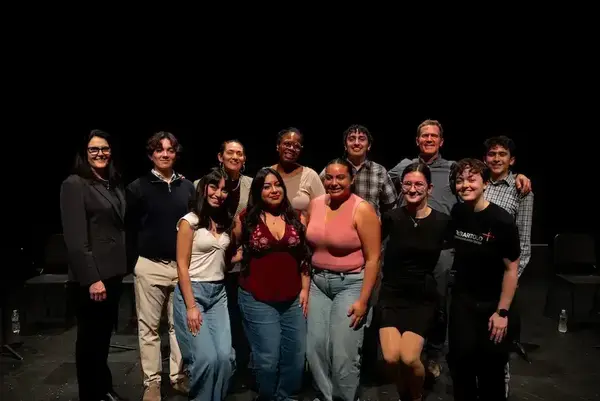
Arts & Letterstag:franco.nd.edu,2005:News/1811882026-04-28T12:13:00-04:002026-04-28T12:13:31-04:00Notre Dame alumna Dolores Díaz returns to campus for staged reading of George Washington’s Mexican BirthdayPlaywright Dolores Díaz (2nd row, 3rd from left) with University of Notre Dame students and faculty on stage at the DeBartolo Performing Arts Center following the staged reading of George Washington’s Mexican Birthday.
Playwright and University of Notre Dame alumna Dolores Díaz returned to campus on Thursday, March 26, for a staged reading of her play George Washington’s Mexican Birthday at the DeBartolo Performing Arts Center. Directed by Gabrielle Randle-Bent, the reading was followed by a post-show conversation moderated by Anne García-Romero, professor in the Department of Film, Television, and Theatre and ILS Faculty Fellow. Earlier that afternoon, Díaz also met with students for an informal conversation in the Julian Samora Lounge in Bond Hall. Díaz, a 2005 Notre Dame graduate, spoke with students about growing up in Laredo, Texas, her path from science to the arts, and the questions of identity and belonging that shape her work.
Set in Laredo, George Washington’s Mexican Birthday follows a group of high school students preparing for the city’s George Washington Birthday Celebration, a setting Díaz uses to explore identity, ambition, radicalization, and the pressures placed on Latiné students as they imagine their futures. The play was originally developed at the 2024 Goodman Theatre New Stages Festival. During her conversation with students in Bond Hall, Díaz reflected on how leaving home can make identity suddenly feel newly visible. “You don’t really think about our identity,” she said, “because it just feels like home.”
That tension between home, perception, and self-definition was central to the day’s conversations. Díaz told students that some of the play’s questions grew out of her own experience coming to Notre Dame and encountering new expectations around how identity is understood and categorized. She also spoke candidly about the challenge of finding belonging on campus, recalling that “it took me a while to find my people.” In another moment, she described her artistic interests as grounded in places where “identity is unstable enough that it is both serious and at times absurd,” a line that helps illuminate the play’s tone and its layered treatment of race, performance, and belonging.
The reading was co-sponsored by the Department of Film, Television, and Theatre, Letras Latinas, which is the Institute for Latino Studies’ literary initiative, the Franco Family Institute for Liberal Arts and the Public Good, and the Teaching Beyond the Classroom program provided by Mr. Earl Linehan and Mrs. Darielle Linehan. The event also grew out of a larger collaboration between ILS and FTT. In a February article previewing the program, Dr. Karen Richman, Director of Undergraduate Studies at ILS and Latino Studies Professor of the Practice, explained that the idea of inviting Díaz emerged after she and students in the Institute's Cross Cultural Leadership Program attended a Chicago production of Díaz’s Black Sunday in July 2024 and later shared dinner and conversation with the playwright. Richman called the prospect of bringing Díaz back to campus “an unforgettably inspired experience for all.”
For Francisco Aragón, director of Letras Latinas and Latino Studies Professor of the Practice, the event also opened up exciting possibilities for future programming. “When Letras Latinas had an office, and was headquartered in Washington, D.C., my love for the theater skyrocketed,” Aragón said. “So when ILS faculty member Karen Richman pitched the idea of bringing Dolores Díaz to campus to stage a reading of her play, I was all in. Plays are a literary art, after all. My hope is that staging a reading of George Washington’s Mexican Birthday was the beginning of a new trend.”
Student participation was central to the performance as well. The cast and production team included Notre Dame students Ryan Madrid, Eny Ramirez, Jenisse Jarquin, Diego Ramos, and Annika Fernandez, along with Notre Dame alumnus Timothy Merkle and local professional actor Jared Fernley. The visit also extended into the classroom, with Díaz and Randle-Bent visiting García-Romero’s “Playwriting” and “Adaptation” courses, as well as Sarah Gitenstein’s “Acting and Directing New Work for the Stage.” Gitenstein, an assistant professor in FTT, also served as a co-producer of the performance.
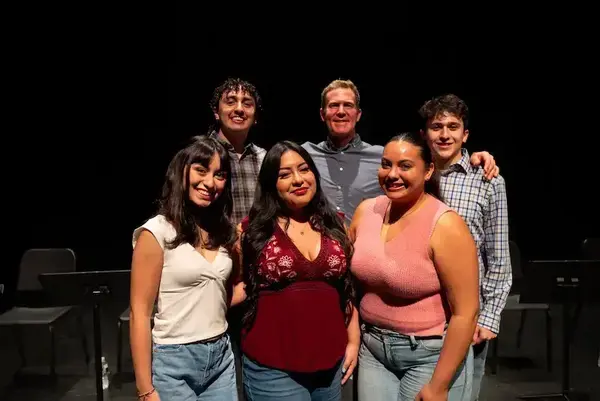
Student performers and faculty gather on stage following the staged reading of George Washington’s Mexican Birthday at the DeBartolo Performing Arts Center.
Annika Fernandez, an undergraduate who participated in the staged reading and played Magdalena Santos, said the experience pushed her into unfamiliar but rewarding territory. “Although I had no prior acting experience and felt hesitant at first, learning more about the storyline sparked my curiosity about the character and encouraged me to take on the role,” Fernandez said. She added that working with Díaz, Randle-Bent, and the rest of the cast was “truly a rewarding experience,” and that the rehearsal process revealed “the level of commitment and passion shared among the entire team.”
Stephania Sanchez, an ILS Latino Studies Merit Scholar, served as an undergraduate research assistant on the project, said the play’s themes resonated deeply. “Serving as an undergraduate research assistant on this project was especially meaningful, as its themes of Hispanic labeling, navigating multiple identities, and cultural celebration deeply resonated with me,” Sanchez said. “Bringing Dolores Díaz back to Notre Dame as an alumna felt powerful, and her work skillfully builds tension for characters you might initially dismiss and ultimately challenge your assumptions.” Sanchez added that students walked away with “a deeper understanding of identity and a renewed appreciation for storytelling as a way to humanize complex experiences.”
Díaz’s return to Notre Dame brought students into conversation not only with a working playwright, but with an alumna reflecting openly on the path that took her from South Texas to Notre Dame and eventually to the stage. In the Julian Samora Lounge, she offered one more piece of advice that seemed to resonate beyond playwriting itself: “Focus on the work, focus on what you can control.” For students navigating their own questions of identity, vocation, and voice, that message felt especially fitting.
Originally published by Parker Gaines at latinostudies.nd.edu on April 23, 2026.
]]>
Parker Gainestag:franco.nd.edu,2005:News/1811872026-04-28T12:12:00-04:002026-04-28T12:12:37-04:00A Question of Justice: Alison Rice
How can language studies amplify marginalized voices?
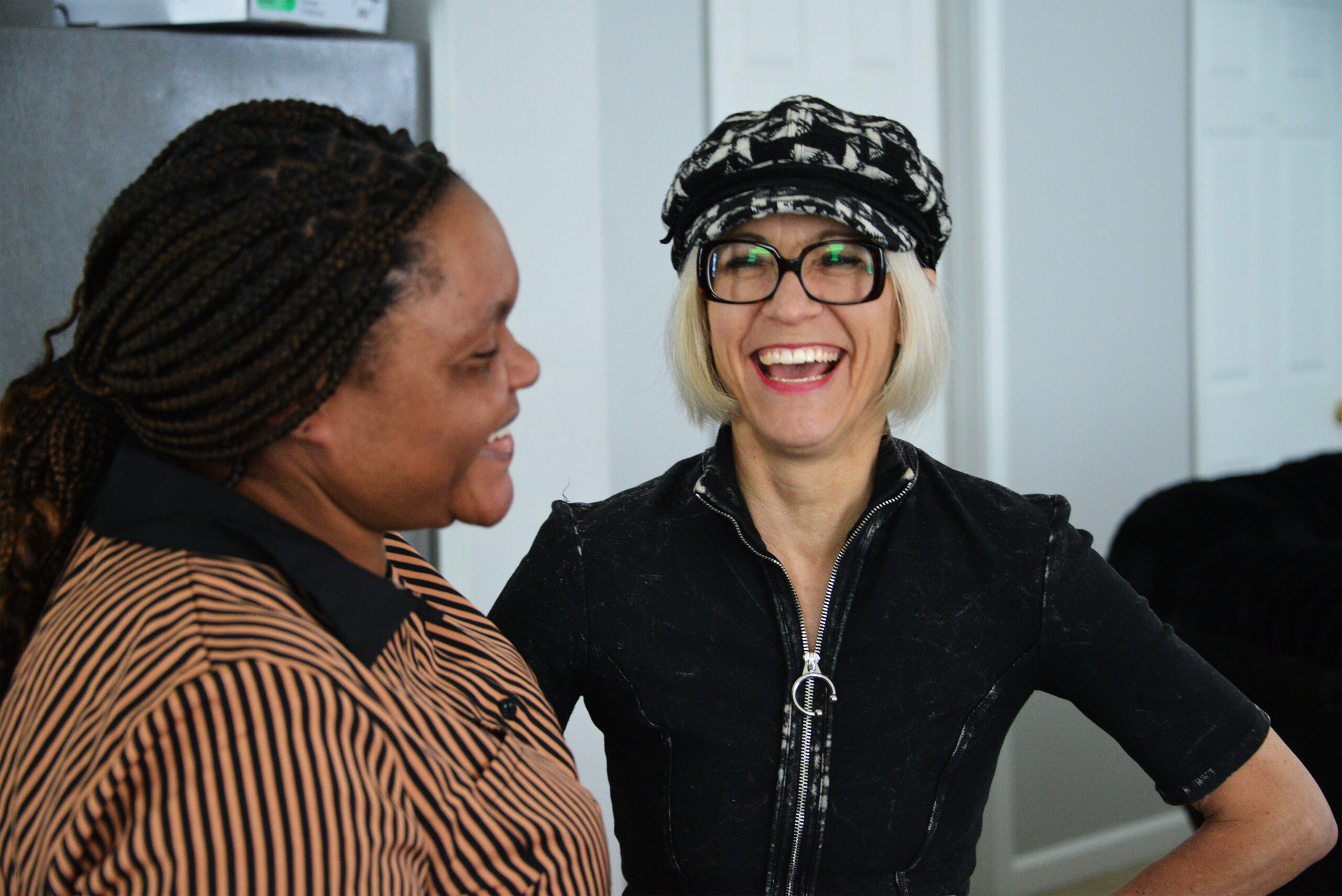
“The study of language is only fully realized when we step out of the academy and into the streets, transforming markers of otherness into bonds of friendship,” says Alison Rice, sitting in the living room of a Francophone refugee family in South Bend, Indiana.
As a professor of French and Francophone studies and chair of the Department of Romance Languages & Literatures, Rice has sought to understand how languages can be used either to divide us—as markers of otherness—or to bring us together by inviting us into the rich and diverse cultures of the people who speak them. Whether delivering an invited lecture in Paris or sharing tea in a refugee’s home, she is motivated by the same goal: to use language to transform otherness into shared human dignity.
Speaking with an accent Rice’s journey toward becoming a French scholar began in the sun-drenched, multicultural mosaic of Riverside, California. Her childhood was a symphony of international voices—Filipino, Chinese, Korean, and Spanish. Yet, it was her immersion in France as a 19-year-old college student that provided her first encounter with linguistic hegemony.
In Paris, classmates called Rice Mademoiselle Dictionnaire, as her obsession with learning a new tongue kept her face buried in a bilingual dictionary. But even as she mastered the vocabulary, she encountered a subtle, persistent barrier: the accent. “To this day, people hear my accent immediately,” Rice says. “They want to know if I’m Polish or Québécoise.”
While Rice came to accept her accent as part of her identity, it also served as a revelation. She learned to see that acoustic marker as a double-edged sword in French society. “When people of diverse origins—perhaps from Africa or the Caribbean—speak with a perfect Parisian accent, nationals often exhibit surprise, as if it’s impossible for them to speak flawless French,” Rice explains. “But if they do have an accent, it becomes an easy way for others to highlight their otherness.” This realization—that language can be used to exclude or to welcome—became the fuel for her research.
Valorizing Francophone women
For her course on the Francophone diaspora, Rice connects Notre Dame students with French-speaking refugees in South Bend to learn about transnational migration from those who survived it.
Rice has made it her mission to shatter the view of French literature that centers “the Hexagon”—or continental France. Her work was catalyzed by reading Assia Djebar, the first North African woman elected to the Académie Française. Rice was fascinated by the way Djebar’s writing uses the language of the colonizer to document the very violence that language has facilitated.
Inspired by this complexity, Rice launched a monumental global project: Francophone Metronomes. Drawing on her relationships with women writers from locations as diverse as Japan, Iran, and Senegal, Rice created an archive of modern Francophone writing that exists both in the digital world and in her acclaimed book Worldwide Women Writers in Paris. Through filmed interviews with 18 women writers, she doesn’t just study these women; she provides them with a platform to tell their stories of resilience and accomplishment. In many cases, these writers welcomed Rice into their private spheres precisely because she treats their accents and otherness not as obstacles to be corrected but as essential parts of their humanity.
What makes Rice’s approach unique is her ability to move beyond the role of a detached researcher. She approaches these writers not as an arbiter of the French language but as a fellow traveler in the experience of otherness. This shared sense of otherness has allowed her to build deep, personal bonds with often reclusive authors. For instance, her relationship with Djebar blossomed from academic study into a close personal friendship that endured until the author’s death in 2015.
The study of language is only fully realized when we step out of the academy and into the streets, transforming markers of otherness into bonds of friendship.
Rice describes her work as “chipping away at the divide” between the French mainstream and the wider Francophone world. By centering and showcasing previously marginalized voices, she is using her influence as an internationally recognized scholar to widen the French literary canon.
Amplifying Francophone work for global human rights
Recently, Rice’s research has focused on how novelists—and other public figures like filmmakers and athletes—leverage their cultural capital to promote human rights.
Rice’s work has highlighted writers like Maïssa Bey, an Algerian high school teacher who published under a pseudonym during the 1990s “Black Decade”—while also founding community centers for women’s expression. Or Fatou Diome, a Senegalese writer who moved to France and wrote a best-selling novel that debunks the myths of immigration—while also using her success to fund sustainable start-ups in her homeland. Or Yanick Lahens, a Haitian writer who remained on the island to empower youth through creative and communal outlets like filmmaking—especially following moments like the 2010 earthquake that rocked the island nation.
“I’ve always been turned off by the idea of solely contemplating a text at a distance from pressing needs that surround us,” Rice says. “I’ve been much more interested in how writers make a difference through their work.”
By elevating women’s voices and researching novelists who leverage their platform for human rights, Rice is demonstrating how language can be a living, breathing tool for connection and a powerful instrument for justice.
Header and pull quote artwork: “Ten Days Until” by Anastasia Trusova Courtesy of the artist Originally published April 15, 2026, at https://socialconcerns.nd.edu/happenings/qoj/.
]]>
Cramer, Davidtag:franco.nd.edu,2005:News/1802922026-03-31T08:25:00-04:002026-03-31T08:26:10-04:00On Beauty and <i>Beowulf</i>: Third workshop of Franco Humanities Fellows wraps up a successful first year
The phrase of the day was “thought experiment.” What kind of objectification might be considered moral? How would a hypothetical vengeful nurse deny the dignity and humanity of a patient? What would it take to create a critically successful Hollywood treatment of an Old English epic?
The third workshop of the Franco Humanities Fellows for the 2025-2026 academic year took place on Thursday, March 19. This workshop culminates a year of interdisciplinary conversation and research among the fellows. The two previous workshops followed work from the broadest range of periods – Faliscan cooks and early Chinese empire, contemporary Chicago soundscapes, the politics and experience of learning disabilities in the present, and how we plan for the future. This final workshop let the fellows dive into representation and language in important and novel ways, and with similarly impressive range, in papers that focused on a single word to a seemingly infinite library of translation, and from Romantic Poetry to midcentury philosophy and science fiction.
The first fellow to present his work was Michael Rea. Rea is a professor of philosophy and this year’s Hesburgh Women of Impact Humanities Fellow with his project Love, Beauty, and Objectification. This book explores the interplay among the three concepts in its title, asking how beauty might ground both love and objectification and teasing out the implications of this dynamic. Kate Kirkpatrick, a philosopher at Oxford University and author of Becoming Beauvoir: A Life (Bloomsbury, 2019), situated Love, Beauty, and Objectification with regards to Simone de Beauvoir’s arguments in her 1946 study The Second Sex. In particular, she explored the consequences of Rea’s work for concepts like “Love of Life” and “Will to Be.” Cristian Mihut, a philosopher at Bethel University and author of Gracious Forgiveness: A Theological Retrieval (Oxford University Press, 2023), posed several hypothetical test cases for Rea’s thinking about empathy in relation to objectifying behaviors and attitudes.
Reflecting on the experience, Rea expressed gratitude for his involvement in the fellows program. “I’m very grateful to the Franco Institute for bringing Kate and Cristian to provide comments. The discussion with Kate and Cris and with my Franco Institute colleagues was enjoyable and quite helpful,” he said. “I’ve really valued the opportunity this year to engage with the work of my colleagues in other disciplines, and I think that this fellowship program provides a tremendous benefit to the College and to the University.”
L-R: guest reviewer Chris Jones and faculty fellow Chris Abram
The conversation continued with Christopher Abram and his project Inventing Beowulf: Innovation and Tradition in the Post-Medieval Poem. Abram is professor of English and fellow of the Medieval Institute. He holds the Decrane Humanities Fellowship among this year’s cohort. His book aims to produce the first comprehensive, critical history of how the most famous Old English poem became a cultural phenomenon in the modern period, and how its changing status across the nineteenth through twenty-first centuries has materially affected the form and substance of the text. Chris Jones, an Old English scholar from the University of Utah, responded. Jones is author of Fossil Poetry: Anglo-Saxon and Linguistic Nativism in Nineteenth-century Poetry (Oxford University Press, 2018). In his comments, Jones praised Abram’s warm and lucid prose and anticipated the book’s warm reception alongside such works as Hugh Magennis’s Translating Beowulf: Modern Versions in English Verse (Boydell & Brewer, 2011). The other fellows joined in the conversation and entertained questions that Beowulf adaptations often raise, including the long debate over the first word of the manuscript ("hwaet") and the perceived undertones of Grendel’s mother and the much-contested depiction of her in Robert Zemeckis’s 2007 film with Angelina Jolie.
"Discussing my work with the other Faculty Fellows and my external reader at the Franco Seminar was one of the most productive experiences of my career," Abram shared. "We so often end up working in isolation in the humanities, stuck in our disciplinary ruts; it was wonderful to share my ideas with scholars who come from very different disciplinary backgrounds. My colleagues read my work carefully, sympathetically, and critically, and they all shared insights from their own fields that will make my book better. It was a pleasure and a privilege to participate," he said.
"The Franco Faculty Fellowship program this year created an exciting forum for interdisciplinary conversation,” said Kate Marshall, Franco Institute Director. On the group wrapping up the first year of the program, Marshall added, “All of our fellows advanced their projects significantly. We are thrilled to welcome a new cohort this fall."
The Franco Institute staff invites everyone to stay tuned for future announcements about the incoming 2026-2027 group of fellows, and we are grateful for the outgoing cohort’s participation, interdisciplinary collaboration, and innovative research.
]]>
Jacob Scheperstag:franco.nd.edu,2005:News/1803292026-03-30T14:24:00-04:002026-03-30T14:25:08-04:00Large Grant winners announced from Franco Institute’s spring 2026 application season
The Franco Family Institute for Liberal Arts and the Public Good recently awarded large grants totaling just under $250,000 to eleven faculty across eight departments in the College of Arts & Letters.
Franco Institute’s large grants support scholarship in three specific areas: the creative and performing arts, conferences and lectures, and research assistance.
Large Creative and Performing Arts:
The Notre Dame Arts Initiative and the Franco Institute award the Large Creative and Performing Arts Grants twice annually to support arts and creative practice projects in any medium that are directed by faculty in the College of Arts & Letters. The Arts Initiative and Franco Institute give special consideration to projects that align with one or more of the Arts Initiative’s current creative practice priorities.
David Bird, assistant professor of music, for the Hinterlands album release.
Roy Scranton, associate professor of English, for Popeye: An American Odyssey.
Rodrigo Lara Zendejas, assistant professor of art, for a solo exhibition at the Contemporary Art Museum of Indianapolis.
Lida Zeitlin-Wu, assistant professor of Film, Television, and Theatre, for “How Color Became a Technology: The Making of Chromatic Capitalism.”
Large Henkels:
The Large Henkels Grant program can cover the costs of an academic conference on campus or in one of the University’s Global Gateways; a series of lectures or performances; or a single, significant visiting lecturer or performer. Departments, institutes, and interdisciplinary groups can bring scholars to Notre Dame for two or more days of public events including a lecture, colloquium, panel, or performance. While all events may not result in a publication, the Institute expects that proposals will be designed with the goal of having a lasting effect beyond a series of lectures or performances.
Kimberly Belcher, associate professor of theology, for “The Work of Human Hands: Timely and Timeless” (April 15-17, 2027).
Jennie Grillo, associate professor of theology, for “Embodiment and Affect in Ancient Judaism and Early Christianity” (May 9-13, 2027).
Victoria Tin-Bor Hui, associate professor of political science, for “The Rise and Fall–and Resilience–of Christian Churches and Civil Society in Hong Kong and in Exile” (May 2027).
Mary Celeste Kearney, professor of Film, Television, and Theatre, for “100 Years Strong But Forever 16: Reclaiming and Expanding Teen Entertainment History” (April 2-3, 2027).
Gabriel Radvansky, professor of psychology, for “Event Cognition Conference” (March 22-24, 2027).
Large Research:
The Franco Institute awards Large Research Grants of up to $25,000 twice annually to support faculty research projects in any department or discipline in Arts & Letters. Large Research Grants can help fund travel to research sites, research assistance, and other expenses associated with data collection and analysis.
Muna Adem, assistant professor of sociology, for “When Is Catastrophic Harm Publicly Recognized? Immigration Enforcement and (Non)Eventfulness.”
Kaylin Hill, assistant professor of psychology, for “Neuroscience for the Public Good: Supporting First-Time Parents.”
]]>
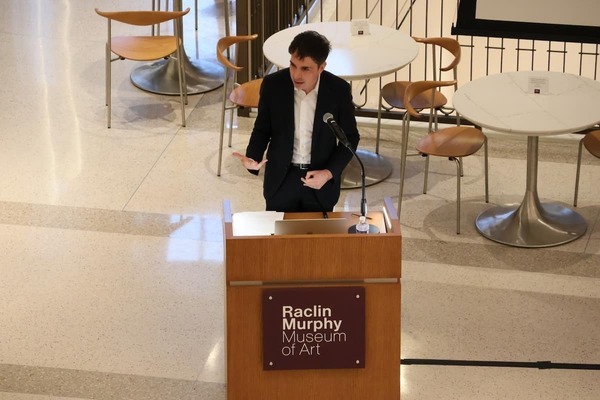
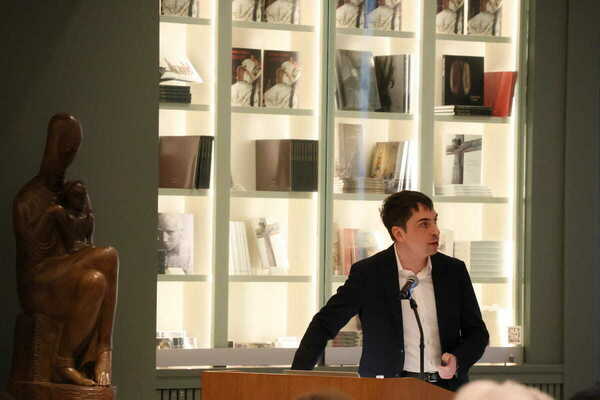
Jacob Scheperstag:franco.nd.edu,2005:News/1799852026-03-26T10:42:00-04:002026-03-26T10:44:18-04:00Art critic Jason Farago shares his thoughts on attention and the artsJason Farago speaking at the Raclin Murphy Museum of Art on February 24, 2026.
How do the arts make us look more deliberately?
How does music let us listen more closely?
How might literature enable us to read more carefully?
How might dance help us feel more strongly?
These are just some of the questions that New York Times art and culture critic Jason Farago explored during his recent visit to Notre Dame on February 24, 2026. The Franco Family Institute for Liberal Arts and the Public Good, the Raclin Murphy Museum of Art, and the Arts Initiative at the University of Notre Dame partnered together to host Farago and hear his thoughts on the current state of the arts and criticism in our moment of divided attention and waning attention spans.
Connecting Students and Professionals
Farago’s visit began with an undergraduate student luncheon co-organized by the Arts Initiative and Beyond the Dome, the College of Arts and Letters' career development program.
The group held an energetic and wide-ranging conversation about Farago’s career path, the role of the critic in society, Emerald Fennel’s new Wuthering Heights adaptation, the value of a liberal arts education, art in the age of AI, and writing in the age of Large Language Models (LLMs).
Farago encouraged students to maintain curiosity about the future while cultivating focus through their studies at Notre Dame. After joking that he "became a journalist by accident" (Farago studied art history, not journalism, at Yale University and the Courtauld Institute of Art), Farago insisted that the skills he gained studying art history set him up for success in a career he had not initially anticipated.
"One of the Arts Initiative's priorities is to cultivate generations of Notre Dame students who see themselves as cultural leaders, not simply cultural consumers, no matter their professional path," says Arts Initiative managing director Rebecca Struch. "Connecting students to successful working professionals like Farago provides them with real-life examples of how to build that somewhat elusive thing known as a 'career' while encouraging them to connect their studies to contemporary conversations about arts and culture they will help shape after graduation. We are immensely grateful to Farago for engaging with our students in such a memorable way."
"There is no better way for our students to gain greater career clarity than to meet with professionals in the industry. Farago’s visit offered us the perfect opportunity to partner with the Arts Initiative to deliver such a high-impact experience for our students,” says Jared Mrozinske, Beyond the Dome’s director. “As our two units grow, we hope to provide even more opportunities like this one so that our students can see firsthand how the foundational skillset they are building in the College of Arts & Letters translates directly to successful careers in the industry."
The Work of Art in the Age of Mechanical Distraction
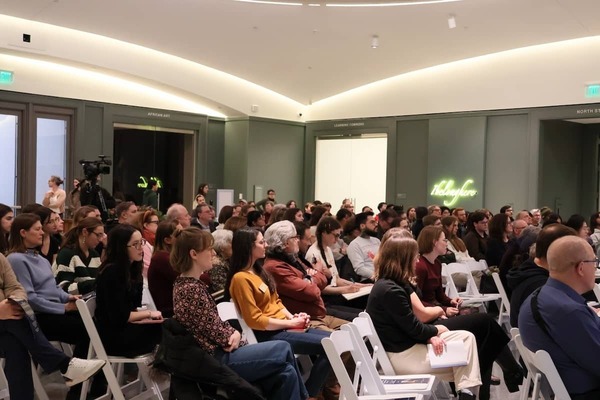
Following the student luncheon and an afternoon touring the School of Architecture and the Raclin Murphy Museum of Art, Jason delivered a lecture titled “The Work of Art in the Age of Mechanical Distraction” in the art museum’s atrium to a crowd of approximately 200 attendees.
The Franco Institute initially invited Farago to campus for this event to tie into the institute's annual research theme of "Attention." In the lecture, Farago spoke about how contemporary artists have responded to technology and how it affects how we encounter art. He offered positive prescriptions for creators and viewers alike. He shared readings and interpretations of various artworks, with special emphasis on Sun & Sea (Marina), the 2019 Golden Lion-winning immersive opera by Lithuanian creators Rugilė Barzdžiukaitė, Vaiva Grainytė, and Lina Lapelytė.
The Raclin Murphy student guides attended Farago's lecture alongside the general audience. Olivia Schmitt, one of the student guides, was present at both the student luncheon and the evening lecture. "It was exciting to hear from someone who has so successfully integrated a passion for art and the liberal arts into a journalism career," Schmitt said. "I particularly enjoyed hearing Mr. Farago's thoughts on what 'impact' and 'success' mean for art museums in an era dominated by distracting devices—and I was thrilled to learn that he, too, was once a student guide at his university museum as an undergraduate!"
Kate Marshall, Director of the Franco Institute, situated the relevance and insights that Farago brought to ongoing campus conversations. "Farago's lecture highlighted so many aspects of the conversations we've been having across the College this year on the topic of attention but with a powerful sense of how these questions are especially urgent for thinking about contemporary art and our encounters with it,” she said. “Jason Farago made a compelling case for the importance of attention to attention."
Jason Farago is a critic at large for The New York Times, writing about culture and its place in the wider world. He is an art critic and columnist who regularly contributes to The Guardian, The New Yorker, and The New Republic. In 2023, he was a finalist for the Pulitzer Prize for criticism.
]]>
Jacob Scheperstag:franco.nd.edu,2005:News/1802542026-03-24T14:29:00-04:002026-05-22T14:12:47-04:00Nineteen scholars research “Attention” through the Franco Institute’s 2025-2026 Annual Research Theme Grants
At the beginning of the current academic year, the Franco Institute launched its sixth annual research theme: “Attention.” In addition to awarding grants to faculty and graduate students, the Institute will host the inaugural Dorothy Day and Thomas Merton Culture and the Public Good Symposium on April 10, 2026, which takes up the attention theme by asking the speakers “How should we hold attention?”
Over the past year, the Institute awarded nineteen Annual Research Theme grants to faculty and graduate students in the College of Arts & Letters. With the Franco Institute’s support, scholars in anthropology; art, art history, and design; English; peace studies; political science; psychology; Romance Languages and Literatures; sociology; the Technology and Digital Studies Program; and theology are researching diverse locales—including Kenya, Brazil, the Philippines, Mexico, Turkey, and Nepal—as well as South Bend.
Six projects deal directly with the so-called “attention economy” and how digital technologies affect and monetize human attention. These projects examine how technology—from TikTok and AI to social media algorithms—actively reshapes, fragments, or undermines attention. Abigail Hemmen, a doctoral candidate in political science, examines how intermingling news headlines with non-news content on social media feeds can trivialize politics. Taking a global perspective, political science and peace studies graduate student Ali Altiok studies how Kenyan youth confront AI-generated political disinformation and deepfakes in order to assess the efficacy of targeted digital literacy education. In a similar vein, Gessica de Freitas, another graduate student in political science, studies how informational overload in Brazil’s complex electoral systems undermines voters’ democratic focus and memory. From a psychological lens, graduate student Lauren Garner investigates the extent to which TikTok may be negatively influencing sustained attention and contrasts those effects with guided meditation practices. Alexi Orchard, an assistant teaching professor in the Technology and Digital Studies Program, proposes that people could seek to emulate generative AI’s capability of processing long text sequences while preserving context. For Orchard, humanities-led expertise can help to develop deep context and evidence-based reasoning rather than accepting superficial or misleading information without much scrutiny. Putting these concerns into practice, associate professor of studio art Jason Lahr translates the “mire of memes” and the experience of “doomscrolling” into the slow, contemplative practice of painting. Lahr is preparing this work for upcoming exhibitions.
Three grantees in psychology focus on the internal mechanics of attention: how it is controlled, how it fails, and how its dysregulation leads to adverse psychological outcomes. Psychology professor Brad Gibson researches whether chronic boredom reflects an impaired voluntary “internal attention” and is developing a model to measure this untested hypothesis. The question of what happens from too much attention is the question that Ryan Carpenter, assistant professor of psychology, seeks to answer. Carpenter explores how an “over-focus on reward” may act as a common link between addiction and nonsuicidal self-injury (NSSI). Psychology graduate student Aurora Roghair investigates the link between environmental lead exposure and ADHD in South Bend-area children. Her study will provide home lead-testing kits to caregivers and her findings can inform community-based screening and early detection.
A few scholars cast attention in terms of its implications for power, justice, and institutions. Their projects treat attention as a political resource and investigate who is granted "regard" and whose suffering is systematically ignored or silenced. The “moral economy of care” within Nepal’s medical system is the focus of anthropology graduate student Prakash B K’s research into clinical attention through twelve months of ethnographic fieldwork. Collective memory and media depictions feature heavily in graduate research from Giulia Maria Gliozzi in Italian Studies and Fabían Díaz Maldonado in sociology. Gliozzi examines how postwar institutions in Italy directed public attention away from specific Holocaust testimonies. Maldonado considers attention within the context of media portrayals, asking how partisan media frame certain social movements to be deemed “worthy” of public attention. Through this work, Gliozzi and Maldonado advance our understanding of attention’s role in conditioning public responses to public memory and collective action.
Other scholars pick up on these themes and investigate attention in relation to memory, resilience, and cultural witness. Communities and their relationship to memory are the focal point for both Insha Bint Bashir, a graduate student in anthropology, and Jorge Manuel Arredondo Sevilla in theology. Bashir investigates attention as collective infrastructure. Drawing on science and technology studies, her work explores how communities cultivate shared practices of care, documentation, and accountability across sociotechnical systems where data access and preservation remain uneven and uncertain. Sevilla is working on a novel which explores how Indigenous Mexican communities have resisted cultural erasure. Anthropology graduate student Melis Gemalmaz envisions attention as a form of solidarity and a spiritual and ethical practice as it emerged in Antakya, Turkey, after the 2023 earthquakes. She studies how the act of attending to another’s suffering and welfare acquired renewed significance within a crisis.
Some projects consider the narrative potential of attention by examining how attention to objects, art, and storytelling can create meaning and therapeutic outcomes. Tirna Chandra, a graduate student in English, examines attention to objects and materials in narratives by First World War female medical caregivers as a therapeutic tool for trauma. For anthropology graduate student Jeremi Panganiban, physical objects and activities also tell the story of attention. Using photographs, storytelling walks, and community mapping, Panganiban studies how coastal residents in the Philippines use “noticing” to document and navigate ecological and economic transitions from fishing to tourism.
Shifting to visual arts more explicitly, art historian Elyse Speaks researches how sculptors in the 1970s and 1980s combined organic, found, and industrial materials; she argues that these artists use such materials specifically to direct attention to the resulting “entanglements.” In the Department of Romance Languages and Literatures, assistant professor Johannes Ruhland looks at the use of medieval “exempla” in thirteenth-century texts. By analyzing these illustrative anecdotes, Ruhland asks whether the era’s French historians acted as “attention seekers” to teach their audiences how to lead moral lives. Ultimately, these studies demonstrate that such modes of attention are not only about seeing but also about caring, remembering, and acting.
A few notable insights emerged out of these varied research projects. Almost every discipline explicitly viewed attention not only as a mental faculty but also as a finite resource claimed by various platforms and social structures. The scholars draw clear distinctions between “fast” attention (TikTok, deepfakes, and doomscrolling) and “slow” attention (ethnographies, painting, archival research, and meditation). Ultimately, this research suggests that the simple act of “paying attention” to another human is, in itself, a political and ethical act. The Franco Institute is proud to support this work demonstrating the innovative research in the College of Arts & Letters.
]]>
Jacob Scheperstag:franco.nd.edu,2005:News/1799762026-03-13T12:14:00-04:002026-03-13T12:14:27-04:00Award-winning writer N. K. Jemisin speaks in South Bend at a Franco-sponsored event
“People forget that science fiction is not really about the future but about the author in the present and what they’re concerned by.” So said best-selling and award-winning writer N. K. Jemisin in her recent visit to South Bend. Her visit signals the Franco Institute’s first off-campus public event in what will be an annual community series and was sponsored by the John and Patrice Kelly Endowment for Excellence.
On Tuesday, March 3, an audience of booklovers from the Michiana community and Notre Dame joined Jemisin at Stockroom East across from Howard Park in downtown South Bend. The event showcased Jemisin’s great ability to create work that serves as a powerful testament to how speculation and genre are among the best tools we have available to understand and act on our most difficult present dilemmas.
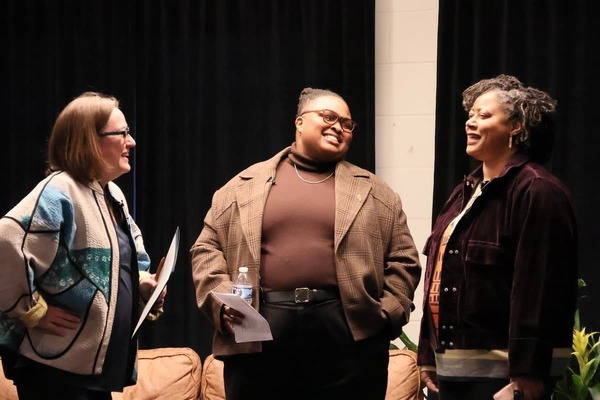
L-R: Kate Marshall, Cham Moore, and N. K. Jemisin
The event consisted of a fireside-style chat with the author, joined by Franco Director Kate Marshall and Cham Moore, an assistant professor of English at Butler University and 2021 Notre Dame Ph.D. A warm reception and book signing followed the discussion.
The conversation was enthusiastic and wide-ranging, centering around topics of hope and community. As Jemisin said, “It’s not jadedness I’m reaching for in my audience.” She expressed her staunch belief in the humanities and gave a ringing endorsement and vote of confidence in their importance. In particular, Jemisin shared her view that “Where bad literature projects [darker] human fantasies, good literature of whatever genre promotes and explores the human condition.”
Jemisin reflected on growing up Gen X and dividing her childhood between New York City and Mobile, Alabama and the independence expected of her. She also shared about her swift, unexpected rise in popularity as a writer and how she made the transition from her previous career in higher education administration as an academic counselor and internship coordinator. “For the first forty years of my life,” she said, “I was someone who just wrote stories for fun.”
After attending the Viable Paradise writing workshop, she began seeking publication in earnest. Although she acquired an agent in 2005, her first novel (The Killing Moon, eventually published in 2012) did not initially sell, as the genre at the time was significantly less welcoming to inclusive fantasy. Instead she rewrote from scratch an old "trunked" novel – which sold at six-figure auction to become The Hundred Thousand Kingdoms (2010) and its sequels. In 2016, her novel The Fifth Season (2015) won the Hugo Award for Best Novel, making Jemisin the first black person to have won in this category. In 2017 she won again for The Obelisk Gate (2016), and then a third time in 2018 for The Stone Sky, making her the first author in genre history to have won the Best Novel Hugo three consecutive times. In all, her short fiction and novels have won Hugos, a Nebula, and two Locus Awards, and have been translated into more than 20 languages. She is a MacArthur 2020 Genius Grant Fellow.
Jemisin advocated for diverse artistic endeavors and spoke about her own experience beyond her fiction to include scriptwriting for her television treatments and creating her graphic novel Far Sector with DC Comics’ Green Lantern line. As she said, “Trying different media helps me become a better writer.” In fact, while critics have often described Jemisin’s work as science fiction and fantasy, she resists applying such labels to her own writing. “I don’t draw lines. Period. I constantly remind myself that genre lines are marketing distinctions. Science fiction is just the vehicle I’ve found to tell my stories,” she said. Summing it up, she said, “Art is an urge to create. It is not bound by medium.”
Moore expressed excitement about moderating “such a dynamic conversation with Jemisin about how her stories are acts of nature that demand to be born onto the page, no matter the genre or medium.” Moore added, “Her writing is all a part of the same organism of powerful stories with a powerful impact for those that read them.”
]]>
Jacob Scheperstag:franco.nd.edu,2005:News/1788032026-01-29T16:05:30-05:002026-01-29T16:05:30-05:00Franco Humanities Fellows showcase interdisciplinary methods
On Thursday, January 22, the Franco Institute held its second workshop for the 2025-2026 cohort of humanities fellows. Two of this year’s fellows shared work from their in-progress manuscripts with distinguished guest scholars and faculty colleagues. The research from both faculty members incorporated a wide range of methods across disciplines and focus areas to illustrate their innovative scholarship.
Alex Chávez, associate professor of anthropology and the Linehan Humanities fellow, presented an excerpt from his manuscript Sound City: Place, Poiesis, Xicago. This book project situates how sound is enacted within and upon Latinx communities in Chicago. Chávez's work employs interdisciplinary methods from an anthropological perspective to join together Latin American studies, urban studies, and sound studies.
(L-R) Faculty fellows Brian Krostenko and Alex Chávez
Ann Mische, associate professor of sociology and peace studies and the Sheedy Humanities Fellow, shared a chapter from Futures in Contention: Public Scenarios and Transformative Politics in the Global Arena. In this work, Mische draws on various disciplines including sociology, political philosophy and theology. She uses case studies, reports, and interviews to ask why scenario methodologies emerged transnationally as a tool for public deliberation and to explore what effects these techniques have on debates and interventions in response to critical global problems.
(L-R) Ann Mische and guest reviewer Iddo Tavory
The final workshop for the remaining humanities fellows will take place in March to round out the cohort’s collaboration and mutual feedback.
Franco Humanities Fellowships support full-time research in the humanities by individual faculty in Arts & Letters. Each humanities fellow receives relief from teaching and service responsibilities for one semester while receiving full salary and benefits.
Humanities fellowship applications are due on February 1 along with applications for public fellowships and mid-career fellowships.
]]>
Jacob Scheperstag:franco.nd.edu,2005:News/1785192026-01-22T14:57:00-05:002026-01-22T14:59:02-05:00Franco Institute's Undergraduate Public Humanities Internship is underway for spring 2026
The Franco Institute kicked off its inaugural semester of the Undergraduate Public Humanities Internship (UPHI) in the spring of 2026.
The internship comes as part of the Franco Institute’s expanded mission to foster the liberal arts’ engagement with the public good. As a disciplinary focus, “public humanities” bridge the gap between scholarly production and public engagement, fostering collaborative efforts to explore the world and our uniquely human place within it. The UPHI offers students the opportunity to use their humanities skills in service to their community while learning how knowledge is produced through the lives, actions, and experiences of community members.
This year's seven student interns from the College of Arts & Letters met together for breakfast and orientation on Friday, January 16, with Franco Institute staff members Lindsay Paturalski, Jake Schepers, and Emmanuel Ojeifo. The students learned about the internship’s expectations and explored best practices and methodologies for public humanities research.
All students receive support from the Institute during the spring 2026 semester as they work with their respective community partners and prepare research related to this year's annual research theme of Attention. In addition, the interns will present their work as part of a poster session at the Institute's Day | Merton Symposium in April. "It's exciting to see this terrific cohort of Arts & Letters students working at the interface of humanities research and the publics to whom it matters. We're looking forward to a great first semester of public humanities work and to celebrating that work at our spring symposium," said Kate Marshall, the Institute's Director.
The Franco Institute is pleased to share its incoming class of the Undergraduate Public Humanities Internship:
Elizabeth Coleman (Psychology, Pre-Health) with Reins of Life
]]>
Jacob Scheperstag:franco.nd.edu,2005:News/1786232026-01-22T11:12:00-05:002026-01-22T11:12:45-05:00A ‘cross-pollination of ideas’: Interdisciplinary research collaborative brings virtue ethics into AIPatrick Gamez (left) and Tom Stapleford discuss their ideas in the Franco Family Institute for Liberal Arts and the Public Good. (Photo by Jon L. Hendricks/University of Notre Dame)
Imagine talking to your favorite stuffed animal — something you confide in at 7 years old because you know that an inanimate object won't share your secrets, invalidate your feelings, or question your motives.
But what if it starts talking back? For today's and tomorrow's children, that's likely to become a common reality.
A Silicon Valley startup has created a stuffed animal with a Wi-Fi-enabled voice box, linked to a chatbot powered by generative artificial intelligence. The company promises lively companions that can elevate children’s play with stimulating conversation, and in order to prevent parental concerns about the content of chats, it’s designed its toys to stay cheery and avoid inappropriate topics.
Tom Stapleford isn’t so sure that forethought goes far enough.
“Bringing folks together from different parts of the University, you make connections you had no idea about because you didn’t even know that this research existed, much less that there was somebody at Notre Dame working on this area." - Tom Stapleford, associate professor in the Program of Liberal Studies
“None of that addresses the question, ‘Is it really good for children to be engaging with a chatbot?’” said Stapleford, an associate professor in the Program of Liberal Studies and scholar of the history of science and virtue ethics at the University of Notre Dame.
Stapleford and colleague Patrick Gamez argue that if AI will actually help humanity, there’s a need for more than just regulations — there’s also a need to consider how AI can enable and facilitate human well-being.
“What we wanted to do was convene a network of researchers and provide a space for them to pursue interdisciplinary research,” said Gamez, an associate teaching professor in the Reilly Center for Science, Technology, and Values and director of its five-year dual degree program in the College of Arts & Letters and College of Engineering. “It’s through the cross-pollination of ideas with a bunch of people from different backgrounds that these projects grow.”
Before the collaborative, Stapleford and Gamez knew of other Notre Dame researchers working to answer generative AI questions, but the lab’s workshops brought everyone together to share ideas and research, as well as their questions and doubts about the largely uncharted field.
Those conversations included Lisa Schirch, the Richard G. Starmann Sr. Professor of the Practice of Peace Studies in the Keough School of Global Affairs, who is using AI systems to facilitate democratic discussions. Alexi Orchard, an assistant teaching professor in Arts & Letters’ Technology and Digital Studies Program, is gathering data on interactions between generative AI and her students — one of the groups most impacted by the rise of AI. In an August workshop, Gamez presented his research on the intertwined histories of AI and counterintelligence, and Stapleford discussed AI and labor.
“Bringing folks together from different parts of the University, you make connections you had no idea about because you didn’t even know that this research existed, much less that there was somebody at Notre Dame working on this area,” Stapleford said. “It just sends out sparks in all kinds of different directions.”
Analyzing AI’s potential for good
The collaborative began as a reading group led by Robert Goulding, an associate professor in the Program of Liberal Studies and director of the Reilly Center. The group discussed the work of German philosopher Martin Heidegger in relation to AI and language — which seemed important as large language models like ChatGPT began to produce more humanlike speech, Gamez said.
To him and Stapleford, the reading group proved the value of philosophical, interdisciplinary conversations around AI, and they wanted to keep talking.
Patrick Gamez (left) and Tom Stapleford talk the future of internet search in the Franco Family Institute for Liberal Arts and the Public Good. (Photo by Jon L. Hendricks/University of Notre Dame)
Along with Goulding, the researchers began working on an application for a National Endowment for the Humanities grant to continue researching AI and the humanities at Notre Dame. And when they received Franco Institute funding to start their research collaborative, they saw an opportunity to further develop the ideas in their grant proposal and bring more scholars into the effort.
“At each workshop, all sorts of themes come up,” Gamez said. “We heard talks about empathy and spirituality and freedom — all sorts of dimensions of our interaction with AI agents.”
Discussions fostered through the collaborative brought the idea of AI’s agency to the forefront. Agency is a complicated concept to conclusively characterize, and its definition and application can vary from scholar to scholar. For example, an engineer might say ChatGPT is an agent because it behaves intelligently, but a philosopher may disagree, arguing that a being needs consciousness to be an agent, Gamez said.
Balancing these perspectives, the Collaborative found value in using the agency of AI as a lens for their analysis.
“AI systems respond to their environment in a dynamic way, and even though they’re not consciously striving after goals, they have certain functions that they’re trying to maximize,” Stapleford said. “We want to recognize that and find helpful ways of talking about it.”
In categorizing AI as an agent, members of the collaborative were able to apply the concepts of virtue ethics, a philosophical approach that gets at the key differences between avoiding bad and doing good. If AI is an agent, AI has the potential to do good, to help people do well — though figuring out how to make that happen is another undertaking entirely.
“What can we do to craft AI systems such that they really enable and facilitate human flourishing?” Stapleford said.
Guiding the future with virtue
The Notre Dame Program on AI and the Development of Ethics in Agents (ND-PAIDEIA) will attempt to answer that question. The proposal crafted by members of the collaborative won a three-year, $500,000 NEH grant to establish a permanent research operation and continue what the workshops started.
“It seemed important to all of us that the Reilly Center should help to build this network because we are, by definition, a place for the interdisciplinary, humanistic, and social study of science and technology,” Gamez said.
The program will feature three distinct themes, providing scholars with various contexts through which to explore agency and ethics in AI: virtue, human judgment and creativity, and politics and democracy. Program members will continuously conduct research and craft policy suggestions within these themes, such as how AI can be effectively implemented in the city of South Bend.
“There just is nothing like what we are in the process of putting together anywhere else right now.” - Patrick Gamez, associate teaching professor in the Reilly Center for Science, Technology, and Values
A workshop in January will aim to draft a paper to outline a virtue-based approach to the development and implementation of AI systems.
“It’s intended to be a kind of a practical guide,” Stapleford said. “It’s going to suggest how research in philosophy and virtue ethics can help programmers and managers who want to design AI systems that will be beneficial for the people in their communities.”
In May, a public conference will call for papers addressing different questions and concerns related to virtue and generative AI. ND-PAIDEIA will also present the workshop results to receive feedback, which they’ll use to refine the paper over the summer.
The following academic year will see ND-PAIDEIA’s first hackathon, with multidisciplinary teams of undergraduate students collaborating on research projects that involve developing or using AI systems. Students will also participate in trainings on virtue ethics and AI.
Fitting the theme of human judgment and creativity, the first hackathon will focus on translation. Because translators can’t just map words one-to-one across languages, translation is a significant application area for AI.
“What happens when we outsource the translation process to an AI system?” Stapleford asked. “What happens when we don’t have humans making judgments about it? Where can things go wrong?”
In its third year, ND-PAIDEIA will aim to produce more research and host a second hackathon, in partnership with the City of South Bend and local community groups interested in implementing AI systems.
In addition to providing students with an opportunity to contribute to ND-PAIDEIA’s research, the hackathons will also serve as a platform where authors of the paper can witness firsthand how their work can make a difference.
“We set up these ideas in the paper — what is it like to try to put them into practice?” Stapleford said.
He and Gamez are hopeful the work of ND-PAIDEIA will make virtue a larger priority in the broader conversation on AI ethics. Virtue isn’t a common topic in the field, and it’s almost unheard of for an AI research center to be based in the humanities. But the scholars of the collaborative have seen what the humanities have to offer, and they’re ready to continue their unique exploration.
“There just is nothing like what we are in the process of putting together anywhere else right now,” Gamez said.
Originally published by Adah McMillan at al.nd.edu on January 22, 2026.
]]>
Adah McMillantag:franco.nd.edu,2005:News/1769792025-12-03T12:31:00-05:002025-12-03T14:09:02-05:00Franco Institute supports research of more than 150 faculty and students in fall 2025
The Franco Family Institute for Liberal Arts and the Public Good awarded grants and fellowships totaling over $600,000 to more than 150 scholars and students from its fall 2025 application season. This funding showcases the Franco Institute’s commitment to liberal arts scholarship at Notre Dame.
Close to 50 undergraduates received funding for student-led research projects, and 50 graduate students and over 60 faculty received support for their scholarship. These faculty and students represent over a dozen disciplines and departments across the humanities and social sciences.
“Research in Arts & Letters is thriving, and it’s tremendously exciting to be able to champion both independent and collaborative projects,” said Kate Marshall, Director of the Institute. “We are seeing faculty and students across the arts, humanities and social sciences moving in new directions as well as contributing to traditional fields.”
Here are just a few of the research projects and grant programs that the Franco Institute supported this semester.
Large Research Grant
These internal grants can help fund preliminary work or data collection on large projects.
Essaka Joshua, English, Disability and Romantic Theatre 1780-1840
Cheng Liu, Psychology, Emerging Pathways for Next Generation STEM Education: Applications of Artificial Intelligence and Quantum Computing for Cognitive Diagnosis
Abigail Ocobock, Sociology, The Uncoupling of Identity and Behavior: A Longitudinal Study of Bisexuality
Guillermo Trejo, Political Science, Where Are the Good Samaritans in Violent Democracies? Designing and Evaluating a Citizen-Led Public Campaign to Stimulate Empathy and Solidarity with 2,000 Victims of Enforced Disappearance in Acapulco, Mexico
Large Henkels Conference Grant
Henkels grants contribute to the costs of an academic conference on campus or in one of the University's global locations; a series of lectures or performances; or a single, significant visiting lecturer or performer.
Michael Coppedge, Political Science, International Conference on AI-Driven Modeling and Forecasting for Democratic Development and Decline (AIM4D Conference)
Brian Krostenko, Classics, Politics, Power, and Rhetoric in the Generation before Cicero
Nicholas Lombardo, Theology, The Holy Spirit and the Trinity: The Idea of a Circular Procession
Events Co-Sponsorship Grants of up to $10,000 support annual meetings of societies or lectures and events primarily sponsored by another unit at the University of Notre Dame.
Alexis Torrance, Theology, Annual Conference for the Byzantine Studies Association of North America 2026
Expanding Research Access Grant
These internal grants may support open access publishing, translations, and diverse scholarly products designed to expand the reach of scholarly research.
Christina Bambrick, Political Science, Constitutionalizing the Private Sphere: A Comparative Inquiry
Joris Geldhof, Theology, Monotheism in Christian Liturgy
Perin Gürel, American Studies, Türkiye, Iran, and the Politics of Comparison
Vanesa Miseres, Romance Languages and Literatures, Mujeres en Tránsito: Viaje, Identidad y Escritura en Sudamérica (1830-1910)
George Sikharulidze, Film, Television, and Theatre, Wish I Didn't Know Now, What I Didn't Know Then
Graduate Working Groups
The Franco Institute's Graduate Working Groups provide doctoral students with additional resources and support to explore questions best addressed through interdisciplinary perspectives.
Westin Smith(Romance Languages and Literatures) and María Alejandrina Tinta-Segovia (Romance Languages and Literatures), Approaching and Teaching Racial and Environmental Resilience
]]>
Jacob Scheperstag:franco.nd.edu,2005:News/1765702025-11-17T11:28:00-05:002025-11-18T09:36:58-05:00Franco Institute hosts three leading academic press editorsFrom left: Kevin Gallin, Fred Appel, Theo Calderara, and Erica Wetter.
On Wednesday, November 12, the Franco Institute welcomed three academic press editors to Notre Dame’s campus.
The three editors – Fred Appel from Princeton University Press, Theo Calderara from Oxford University Press, and Erica Wetter from Stanford University Press – held morning consultations with individual scholars in Arts & Letters on their current book projects. In the afternoon, the editors participated in an academic publishing panel session, which was open to faculty, post-docs, and graduate students. Franco Institute Director Kate Marshall said, “Faculty and post-doctoral scholars in Arts & Letters took great advantage of this opportunity, and each of the visiting editors told us how impressed they were with the quality of research being done in the College. The individual meetings led to many fruitful connections.”
Perin Gürel, associate professor of American Studies, thanked the Franco Institute for hosting the event, saying “Kudos to Franco for creating such a valuable and streamlined experience for scholars in the College of Arts & Letters. The individual meetings were absolutely priceless – timed perfectly for us to relate the project and evaluate matching vision and work styles.” Brandon Menke, assistant professor of English, also noted the consultations’ value. He said, “Being able to discuss my book project with acquiring editors from some of the leading university presses in the humanities, in an invitingly familiar setting here at Notre Dame, was an immeasurably beneficial opportunity for me as a junior faculty member facing this process for the first time.”
The afternoon’s panel took place in McKenna Hall auditorium with over fifty individuals in attendance. Kate Marshall gave opening remarks and then turned the event over to Kevin Gallin, Franco’s assistant director of research development, who moderated the panel. Responding to Gallin’s questions, the editors offered advice on discerning the best “fit” for a book with a press and navigating the editorial review process. A question-and-answer period offered the audience a chance to gain additional insights.
Marshall summarized the event and its importance for the College. She said, “At the publishing panel, the expertise of the editors across humanities, arts and social science fields met with the curiosity of a highly engaged audience. The event is a highlight in our professional development offerings for the College.” Gallin also reflected on the entirety of the day’s events, saying “We were really pleased to see so many enthusiastic one-on-one conversations happening in our offices in the morning, and to follow that up with such an excellent panel in the afternoon was really exciting.” He went on to thank the editors for their generosity and insights: “I'm grateful for our panelists for sharing their experience and insights into the process for getting a book to print, and I have no doubt that the faculty, post-docs, and graduate students in attendance walked away with practical next steps for their research."
As with the morning consultations, participants across Arts & Letters expressed gratitude for the publishing panel session. Gürel noted, “The afternoon panel gave specific and applicable advice for first-time authors and further demonstrated the importance of ensuring a match between press, editor, and author.” Menke, too, remarked on the notable opportunity, saying that it “offered scholars at all stages on the pathway to publication the extraordinary chance to address their queries directly to the very editors who might one day help bring their books into the world.”
]]>
Jacob Scheperstag:franco.nd.edu,2005:News/1760582025-10-28T16:00:16-04:002025-10-28T16:06:03-04:00Two Franco Humanities Fellows write and connect through National Humanities Center residency
Notre Dame associate professors Brian Krostenko and Alex E. Chávez, from the departments of Classics and Anthropology, respectively, kickstarted a summer of writing and research through the National Humanities Center’s Summer Residency Program.
Brian Krostenko, left, and Alex Chávez stand outside the National Humanities Center Archie K. Davis Building. The two Franco Humanities Fellows spent the month of June working on their respective books at the NHC in the company of other scholars.
The NHC is a private, nonprofit organization dedicated to elevating the liberal arts through fellowships and educational outreach. The residency program brings exceptional scholars to the NHC’s North Carolina facility to spend four weeks solely working on a current project. Summer residents are supported with library materials, professional development sessions, and the opportunity to connect with scholars from around the country.
Franco will continue its support of the residency, and tenure-line faculty interested in participating in the 2026 program should email Kevin Gallin (kgallin@nd.edu), assistant director of research development for the Franco Institute, by Friday, Oct. 31; the Franco Family Institute will manage the internal nomination process.
“We are proud to support Alex and Brian’s excellent work by sponsoring their summer fellowship at the NHC,” Gallin said. “We look forward to seeing how their work advances from here, and to continue our support for research — and scholars — across the College.”
Reframing ancient rhetoric
Krostenko came out of his NHC residency with two new book chapters and some unexpected connections.
His upcoming book, tentatively titled “It’s Our World Now,” will explore the influence of rhetoric on the practice of law in the Roman world, drawing on analysis of the Rhetorica ad Herennium, an ancient Latin text Krostenko describes as a “rhetorical handbook.” Its author gives recommendations on how to speak in certain rhetorical styles with practical examples of good rhetoric and bad rhetoric.
Brian Krostenko, associate professor of classics, speaks during the Franco Institute's first workshop for this year's cohort of Franco Humanities Fellows. Krostenko is spending the 2025-26 academic year solely working on his upcoming book “It’s Our World Now” with the Franco Institute's support.
In his time as a classics professor, teaching the Rhetorica ad Herennium to semester after semester of students, Krostenko has developed a new way of looking at its author’s intentions and message.
“The author is of the view that rhetorical form is a way of helping you think better,” he said. “For him, rhetoric is ultimately a method of training your own cognitive habits, as opposed to distracting people from the truth by something that’s beautiful.”
With that idea in mind, Krostenko is using Rhetorica ad Herennium as a test case to explore the relationship between the beautiful and the useful — how sounding better can mean thinking more clearly and effectively.
Krostenko’s ventured outside his field in his research and in his discussions with other scholars at the NHC. He met people studying topics from Ottoman court records to the impact of protests on text messaging patterns, but conversations with a scholar studying the discourse of astrology were especially enlightening for him.
Astrology — which ties the positions of the stars and planets to human behavior — is often seen as in opposition to science and logic, but can still aid practitioners in confronting uncertainty, Krostenko learned. Recognizing the value of a quasi-rational subject like astrology helped Krostenko see his own work in a new way.
“That sort of act of sympathy with a person who doesn’t agree with you is exactly the sort of thing that helped me deepen my understanding of the ‘bad’ rhetoric I was looking at,” he said.
Sound and historical silence
Chávez approaches the study of cultural anthropology in a unique way — through sound.
Earlier this year, he was selected to give the Galarza Lecture at Stanford University, a high honor for a Latino studies scholar, as past presenters include Dolores Huerta, Luis Valdez, Sandra Cisneros, Renato Rosaldo, Cherrie Moraga, Jorge A. Bustamante, and Notre Dame's own Julian Samora.
Alex Chávez, associate professor of anthropology. As a fellow of both the Institute for Latino Studies and the Initiative on Race and Resilience, Chávez researches the sounds and aurality of the Latino experience across physical and cultural borders.
As a scholar and artist so finely attuned to sound, Chávez notices where there’s silence.
He was first surprised to learn of the robust historical presence of Latinos in the Midwest when he first moved to the area, particularly in Chicago, which is home to the sixth-largest Latino population in the country.
“It’s not something that necessarily registers in our cultural atlas of where we think of Latino communities existing historically — West Coast or East Coast, New York and Miami,” Chávez said. “That presents the question, ‘Why is there silence around the Latino Midwest?’”
His next book, tentatively titled “Sound City: Places, Poiesis, Xicago,” aims to address that silence, to locate the Latino Midwest in America’s placial and racial imagination. Using ethnographic research on sound — found in youth radio, vinyl records, literature, soundscapes, and everything in between — Chávez will tell the story of Latino Chicago.
“How do we hear Chicago, and when we listen, who do we imagine and hear as citizens of the city?” he said. “What are those histories and cultural understandings?”
His summer residency brought him closer to answering those questions. With his on-the-ground research already completed, Chávez just needed time to write — and the NHC provided that and more.
“Carving out time that’s purposeful and intentional can be really elusive,” he said. “But the NHC makes for an ideal place to gather your thoughts and concentrate on writing.”
Originally published by Adah McMillan at al.nd.edu on October 27, 2025.
]]>
Adah McMillantag:franco.nd.edu,2005:News/1757242025-10-17T09:50:00-04:002025-10-17T20:47:00-04:00Franco Institute holds workshop for 2025-2026 humanities fellowsFranco Institute humanities fellows and guest readers
The Franco Institute held its first workshop for the 2025-2026 cohort of humanities fellows on Wednesday, October 8. Three of this year’s fellows shared work from manuscripts-in-progress with distinguished guest scholars and faculty colleagues.
In her opening remarks Kate Marshall, director of the Franco Institute, shared that this meeting was the culmination of an idea two years in the making. She called the Humanities Fellows program an opportunity “to devote substantial time to research while building intellectual community.” As Marshall noted, these workshops signal the Franco Institute’s deep commitment to liberal arts scholarship across departments and disciplines.
(L-R) Humanities fellow Liang Cai and Franco Institute director Kate Marshall
The format for the workshop allowed each of the three fellows to share a contextualizing overview before inviting their external reviewers and Notre Dame colleagues to provide feedback on each manuscript.
Liang Cai, associate professor of history and this year’s Lee Humanities Fellow, welcomed her guest readers, Clifford Ando from the University of Chicago and Mark Csikszentmilhàlyi from the University of California, Berkeley, to respond to her work on convict politics and state power during China’s Western Han dynasty. Ardea Russo and Carrie Gates–both of Notre Dame–served as manuscript reviewers for Debra Javeline, professor of political science and the Murphy Humanities Fellow. Russo and Gates shared their thoughts on Javelin’s memoir detailing her experience as a parent navigating issues related to merit and disability in the US education system. “Meritocracy and My Kid is a mother-daughter disability memoir, which represents an entirely new kind of writing for me that is squarely in the humanities,” Javeline shared.
Humanities fellow Debra Javeline
She noted the importance of the event, saying “The workshop was my first opportunity to share the work, and I felt very grateful for the vibrant and safe space and full engagement of the other fellows.” Rounding out the workshop was Brian Krostenko, associate professor of classics and the Midili Humanities Fellow. Michael Weiss from Cornell University served as Krostenko’s guest reader and provided sociolinguistic perspectives on the Latin text at the center of Krostenko’s project, a dedication by the guild of Faliscan cooks, which offers insights about social class in the Roman Empire.
This first workshop demonstrated the innovation and expertise that Arts & Letters faculty bring to their research on timely and enduring questions in the humanities. Cai reflected on the experience, saying “The Franco Humanities Fellows Workshop offers me a unique opportunity to receive feedback not only from leading scholars in my field but also from the diverse intellectual perspectives of my Notre Dame colleagues, who are experts in various disciplines.” She added, “This rich exchange of ideas has contributed to the cultivation of a vibrant academic community at Notre Dame.”
(L-R) Humanities fellows Chris Abram and Brian Krostenko
The Franco Institute will hold two more sessions, one in January and another in March, to facilitate collaboration and feedback among humanities fellows.
]]>
Jacob Scheperstag:franco.nd.edu,2005:News/1754762025-10-02T15:58:00-04:002025-10-02T15:58:35-04:00How the Catholic Church is responding to immigration policies at the U.S.-Mexico border
Josie Soehnge Cohen is a Ph.D. student in anthropology at the University of Notre Dame. Her research investigates religiously motivated refugee–migrant care practices and political interventions with an emphasis on the role of the Catholic Church — and religion more broadly — in shaping contemporary politics across local, national, and transnational scales.
Josie Soehnge Cohen, right, stands with Sister Norma Pimentel, executive director of Catholic Charities of the Rio Grande Valley. In 2018, the University of Notre Dame honored Sister Pimentel with the Laetare Medal in recognition of her work with immigrants and refugees.
Cohen received funding from the Franco Family Institute for Liberal Arts and the Public Good and the Klau Institute for Civil and Human Rights to spend four weeks this past summer collecting data in the Lower Rio Grande Valley. Her aim was to better understand 1) the role of the Catholic Church in mitigating refugee-migrant humanitarian issues caused by U.S. immigration policies of expulsion, 2) how this role is transforming U.S. asylum governance, and 3) how it is altering the relationship between Church and state actors responsible for immigration policy enforcement.
The results of this project are essential to Cohen’s broader dissertation project that seeks to better theorize the contemporary role of religious organizations in the public and in local governance, allowing us to imagine the structural constraints and conjunctural possibilities of asylum governance aided by faith-based organizations.
Cohen will also present her findings next month in Rome at Migration, a Pilgrimage of Hope, an international conference on migration, theological, and social studies to be held Oct. 21-23 at Pontifical Urbaniana University. The Klau Institute is one of the main co-sponsors of the conference.
Continue reading below for a firsthand account of what she observed this summer along the U.S.-Mexico border. Note: This is original research. Please cite appropriately if referencing these findings in any other work.
The Catholic Church’s Response to U.S. Immigration Policies of Expulsion and Strategic Neglect: Understanding Asylum Governance at the U.S.-Mexico Border
There have been huge changes since the last time I volunteered at the Respite Center in 2023. A Respite Center once full of refugee-migrant families is now totally empty. I got to document firsthand the immediate on-the-ground effects of the current Trump Administration’s immigration agenda. I helped clean, organize, and set up a pre-natal care area, establish a room with clothes for mothers and children, and cook three meals a day for the local houseless population. Because there were not refugee-migrant families living at the Respite Center (due to policy changes that occurred after I planned this field trip), the few remaining staff members and volunteers had more time to talk with me about the work of the Catholic Church in refugee-migrant care since 2014, how the Catholic Church interfaces with other actors, and how things have changed since the beginning of the current presidential administration in January of 2025.
Josie Soehnge Cohen, right, serves food outside the Humanitarian Respite Center in McAllen, Texas.
I established a meaningful relationship with the director of immigration services for the Diocese of Brownsville. This diocese lines the southernmost tip of the U.S.-Mexico border. She has incredible relationships with people and groups involved in refugee-migrant humanitarian efforts as well as with local law enforcement and elected officials. She gave me a work space next to her office and helped connect me to many actors in law enforcement — both local police and lead actors for Customs and Border Protection.
We shared many meals, and she accompanied me to interviews with actors hesitant to talk to outsiders. I was able to conduct extremely illuminating and informative interviews with local clergy and law enforcement.
I took semi-structured field notes during participant observations and recorded and transcribed interviews. Major findings, or results, of this data collection project included:
Families of refugee-migrants went from dozens of families, to eight people, to two people in a matter of weeks following major immigration policy changes of the current presidential administration.
Many non-Catholic humanitarian groups have closed their doors. Catholic organizations are remaining open and using their facilities to do what they can, even though there are no longer refugee-migrants being released by Customs and Border Protection.
Local law enforcement respects the humanitarian efforts of the Catholic Church in the Lower Rio Grande Valley. Local law enforcement does not check for papers or participate in the deportation of undocumented persons for the sole reason of being undocumented. If an undocumented person is arrested and eventually deported, it is only because they were already being arrested for a serious violent crime, such as involvement in child or narco trafficking.
Under the Biden Administration, local law enforcement no longer saw human stash houses (in which refugee-migrants were exploited in horrendous ways by coyotes). This is because refugee-migrants had a legal pathway into the U.S. and no longer needed to rely on organized criminal organizations to smuggle them into the U.S. Local law enforcement anticipates the return of stash houses with the end of asylum at the command of the Trump Administration.
Immigration and Customs Enforcement is not even notifying local law enforcement before or after conducting raids to detain and deport undocumented persons.
Local law enforcement is getting reports of “cazadores” or “hunters” who are regular civilian bounty hunters being paid $500 per head for grabbing and turning in people who they believe to be undocumented to Customs and Border Protection for deportation.
Both the local Catholic Church and local law enforcement are willing to vet and care for refugee-migrants if they are able to enter the U.S. again. Together, the local Catholic Church and law enforcement express that they want refugee-migrants to be able to resume entrance into the U.S.
Unaccompanied minors were previously staying an average of 30 days in the “youth shelters” or youth detention centers before being picked up by friends or family. Since the current administration made changes to the documents required for parents to pick up their children, children have been there for over 150 days with no hope of being reunited soon. Previously, parents could use documents from their origin country to pick up their children from the centers. Now, they need U.S.-issued documents that must be obtained in-person in government buildings. Because parents are afraid they will be detained and deported trying to get documents, they are denied the ability to reunite with their children. This is negatively affecting the children in detention centers for longer periods of time without certainty of reunification.
These findings, so crucial to my broader research agenda, were made possible by the generosity of the Klau Institute’s Graduate Migration Working Group Research Grant and the Franco Family Institute’s Annual Theme Agenda for 2025. These grants covered expenses for airfare, lodging, a rental car, recording and transcription technology, and child care — all of which were necessary for me to complete this data collection.
These grants provided the resources and encouragement necessary for a project that I believe is critical to understanding one of our most pressing social issues and how religious organizations are emerging as key actors in the public.
Visit the Klau Institute’s Grants & Fellowships page to see the variety of funding sources the institute has available for students and faculty researching civil and human rights topics.
Originally published by Klau Institute at klau.nd.edu on September 30, 2025.